
By Godwin Gumbo
The Matebeleland South Province is charting a new course for development, with a focus on positioning itself as a hub for growth and progress. This was emphasized during a recent Ministerial Interface between Minister of State for Provincial Affairs and Devolution, Honourable Albert Nguluvhe, and stakeholders from Bulilima and Mangwe districts.
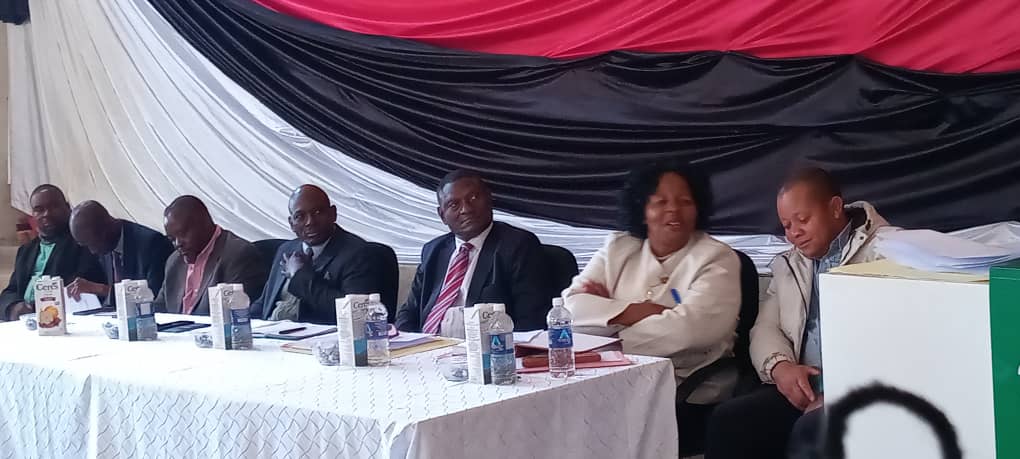
The interface was attended by a diverse range of stakeholders, including officials from Mangwe Rural District Council, Bulilima Rural District Council, and Plumtree Town Council. Also in attendance were traditional leaders, namely Chief Bango, Chief Tshitshi, Chief Madlambudzi, Chief Mphini, Chief Sangulube, Chief Wasi, Chief Hikwa, and Chief Manguba, and headmen from Mangwe and Bulilima, alongside the District Development Coordinators for both districts Mrs R Sawuramba and Mr O Zogara respectively, heads of government departments, council chairpersons, councillors, and representatives of the ZANU PF party. Members of the local business community and other critical development partners also took part in the engagement.
Additionally, senior government officials attended, including the Permanent Secretary for Provincial Affairs and Devolution, Mrs. L.L. Dlamini-Maseko; the Provincial Director of Local Government and Public Works, Mr. Zachariah Jusah; and the Director in the Office of the Minister of State, Mr. Ncube.
In his capacity as Minister of State for Matabeleland South, Hon. Nguluvhe used the occasion to introduce himself formally to local leadership and stakeholders, outlining his vision for the province’s development. He highlighted the strategic role that collaboration between civil society, traditional leadership, government departments, and the private sector plays in achieving meaningful, community-centred development under the framework of devolution. “We are committed to working together to ensure that every community in Matabeleland South benefits from infrastructure development, improved service delivery, and increased economic opportunities,” said Minister Nguluvhe.
The interface brought together government officials, traditional leaders, business representatives, and other key stakeholders to discuss progress and challenges in implementing development projects. Despite some progress in areas such as school construction and road rehabilitation, funded by devolution funds, the districts face hurdles due to delayed disbursement of funds for 2024. “We have made significant progress in various projects since 2019, but the delay in disbursement of funds for 2024 has hampered our projections,” noted Mr B.Mlauzi, CEO Bulilima Rural District Council.
Minister Nguluvhe commended the districts for aligning their development trajectories with the National Development Strategy but noted the need for greater uniformity in development across the seven district councils. “We need to ensure that development is evenly distributed across the province and that every district is given the opportunity to thrive,” he said. The Minister also emphasized the importance of population growth in attracting investment to the province: “A growing population is key to attracting investment, and we need to work together to create opportunities that will attract people to our province.” The Minister acknowledged that the province’s population was far higher than official statistics due to some of its citizens who move to the diaspora before acquiring identity documents.
Minister Nguluvhe further outlined his vision for the province’s development, highlighting the role of collaboration between government, civil society, traditional leadership, and the private sector in achieving meaningful development under the devolution framework. “Devolution is a cornerstone of our national agenda, and we need to work together to ensure that it benefits our communities,” he said.
The meeting concluded with stakeholders committing to work together to realize the full potential of devolution across the province. A seed of collective aspiration to uniformly develop the province of Matabeleland South was sowed in this particular interface meeting and rallying call to effectively implement implement projects that are community centric.

 radiobukalanga.org
Leave a comment